How Much Deposit Do You Need to Buy a House in QLD? A 2026 Guide
Buying a home in Queensland is exciting — but one of the biggest questions people ask is:
“How much deposit do I actually need?”
The short answer?
It depends on your income, property price, and whether you qualify for government support.
In this guide, we’ll break down:
- Minimum deposit requirements in QLD
- The difference between 5% (via the First Home Buyers Scheme), 10% and 20% deposits
- What Lenders Mortgage Insurance (LMI) really costs
- First home buyer support options
- Real examples based on Brisbane property prices
What Is the Minimum Deposit to Buy a House in Queensland?
In most cases, lenders require:
- 10% minimum deposit (with LMI)
- 20% deposit to avoid LMI
Buying With a 5% Deposit under the First Home Guarantee Scheme
If you’re a first home buyer in Queensland, you may not need a full 20% deposit — and in some cases, you may be able to avoid Lenders Mortgage Insurance (LMI) even with just 5% saved.
Australian Government 5% Deposit Scheme
The First Home Guarantee (often referred to as the 5% deposit scheme) allows eligible first home buyers to purchase a property with as little as 5% deposit without paying LMI.
Here’s how it works:
- You contribute a minimum 5% deposit.
- The government guarantees up to 15% of the property value.
- Your lender treats the loan as if you had a 20% deposit.
- You avoid paying LMI.
Example in Brisbane:
Buying a $700,000 home
- 5% deposit = $35,000
- Normally LMI could cost $20,000–$30,000
- Under the First Home Guarantee → No LMI payable (if eligible)
That could save you tens of thousands upfront.
Eligibility generally includes:
- Australian citizen or permanent resident
- Income caps apply (single and couple limits)
- Property price must be under the scheme threshold for Queensland
- Must live in the property (owner-occupier)
Places are limited each financial year and must be accessed through participating lenders.
Pros of 5% Deposit
- Enter the market sooner
- Stop paying rent
- Start building equity
- No LMI payable (if eligible)
Cons
- Higher repayments
- Lower initial equity
- Limited available lenders
What Happens If You Have a 10% Deposit?
A 10% deposit is often a strong middle ground.
Using the same $700,000 property:
- 10% deposit = $70,000
- Loan = $630,000
- LMI applies
This option works well if (Pros):
- You’ve been saving consistently
- If stop renting is a priority for you
Cons
- Limited available lenders
Why a 20% Deposit Is Ideal
A 20% deposit means:
- No Lenders Mortgage Insurance
- Lower repayments
- More lender options
- Stronger negotiating power
On a $700,000 home:
- 20% deposit = $140,000
- Loan = $560,000
- No LMI payable
If you can reach 20%, you’ll save tens of thousands long term.
But — waiting years to save 20% may mean missing market growth.
What Is Lenders Mortgage Insurance (LMI)?
LMI protects the lender, not you.
It applies when you borrow more than 80% of the property value.
In Australia, LMI costs depend on:
- Deposit size
- Property price
- Loan amount
- Employment type
It can range from a few thousand dollars to over $30,000 on higher-value properties.
First Home Buyer Support in Queensland
If you’re a first home buyer, you may qualify for government assistance.
The Queensland First Home Owner Grant currently provides eligible buyers with financial assistance when purchasing or building a new home.
You may also be eligible for:
- Stamp duty concessions
- First home guarantee schemes
- Shared equity programs
These schemes can reduce the deposit required or eliminate LMI entirely (subject to eligibility).
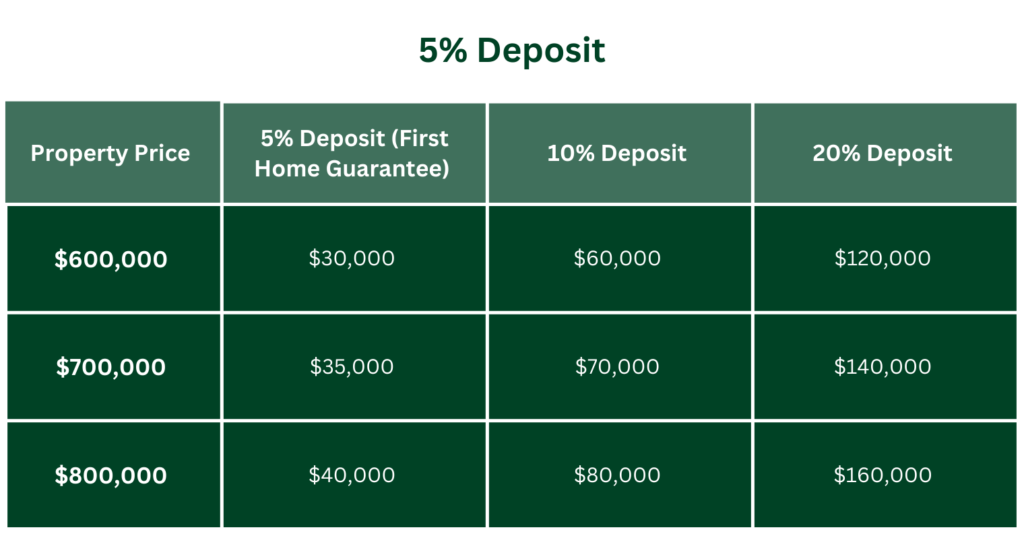
How Much Deposit Do You Need Based on Property Price?
Here’s a quick breakdown:
Remember — you also need to budget for:
- Stamp duty (if applicable)
- Legal fees
- Building & pest inspections
- Moving costs
Is It Better to Wait or Buy With 10%?
This is where strategy matters.
Ask yourself:
- Are property prices rising in your area?
- How long will it take you to save 20%?
- Are you currently paying high rent?
- Do you qualify for first home buyer support?
In fast-growing Queensland markets, waiting 2–3 years to save a bigger deposit can sometimes mean paying more for the same property.
But if your finances are tight, waiting could reduce financial stress.
How to Increase Your Deposit Faster
If you’re close but not quite there:
- Reduce discretionary spending
- Pay down personal debts
- Use gifted deposits (if eligible)
- Consider guarantor options
- Review your borrowing capacity with a broker
Small improvements in savings and debt levels can significantly improve your approval outcome.
The Smart Next Step
The “right” deposit isn’t just about hitting 5%, 10%, or 20%.
It’s about:
- Your borrowing capacity
- Your long-term financial comfort
- Your property goals
- Your risk tolerance
Every situation is different — especially in Queensland’s changing market.
Final Thoughts
You may be able to buy in Queensland with as little as 5% — but whether you should depends on your full financial picture.
If you’re unsure how much deposit you actually need, the best move is to calculate your borrowing power properly before you start house hunting.
Understanding your options now could save you thousands later.
Written by Juan Castano Quirama
Finance Broker
0434 309 884
General Advice Disclaimers
The information provided in this article is general in nature and does not take into account your individual objectives, financial situation, or needs. It is intended for educational purposes only and should not be relied upon as personal financial or credit advice.
Before making any decisions regarding property purchases, loans, or government schemes, you should consider whether the information is appropriate for your circumstances and seek professional advice tailored to your situation.
Loan approvals, interest rates, eligibility for government grants or guarantee schemes, and lending policies are subject to change and individual lender criteria. Not all applicants will qualify.
Do Financial Services Pty Ltd is a licensed mortgage broker and provides credit assistance services. We recommend obtaining independent legal, financial, and taxation advice before proceeding with any property or lending decision.